ENG
SOCIAL ECONOMY IN SPAIN
AS A TRANSFORMATION
LEVERAGE POLICY:
CONFLUENCES WITH PORTUGAL
Maravillas Espín Saez
Director General of Autonomous Work, Social Economy and Corporate Social Responsibility
Spanish Ministry of Work and Social Economy
. . . . . . . . . . . . . . . . . . . . . . . . . . . . . . . . . . . . . . . . . . . . . . . . . . . . . . . . . . . . . . . . . . . . . .
1. SOCIAL ECONOMY IN ESPAÑA: A MODEL TAILORED DO PEOPLE
Social Economy in Spain refers to a set of diverse entities that operate in the economic market, forming a model built according to the needs of people. Its economic and social weight is gaining, intensely, specific value at European level. Indeed, its broad and sustained trajectory of incessant work, attached to the principles that identify it: primacy of people and social purpose over capital; democratic management; promotion of internal solidarity and society and an open commitment to local development, equal opportunities and job creation, attached to this economic model, as a key factor in recovery.
The entities that form Social Economy in Spain enjoy enormous solidity. As such, Spanish Social Economy represents about 10% of GDP and 12.5% of employment, with over 2 million direct and indirect jobs. Recently, the naming of the Ministry of Work as Ministry of Work and Social Economy has clearly shown that the new Government of Spain is waging on acknowledging the relevance of the sector and boosting its visibility as what it is: a model of social and economic transformation, which faces challenges (present and future) as a consequence of covid-19 in our country with the required toughness, elasticity and innovation.
The good data offered by the sector is generated by more than 43,000 entities, although most of them are cooperatives, as shown in the following graph:
[pie chart]
(**) 185 No. of insertion companies
(***) 6,739 No. of Social Economy companies with other legal forms
(*****) 87 No. of Social Economy foundations
(**) 198 No. of Fishermen Brotherhoods
(**) 225 No. of Mutual Associations
(*) 18,635 No. Cooperatives
(*) 8,160 No. labour societies
(****) 8,163 No. disability sector associations
(**) 800 No. special employment centres for Social Economy
Highcharts.com
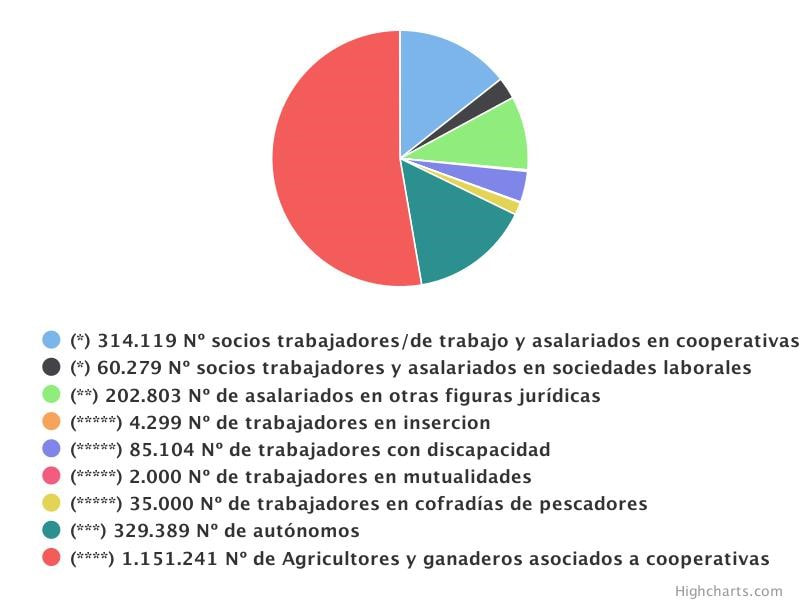
Likewise, the largest share of more than 2 million working people it employs work in cooperatives, more than half of them associated with cooperatives in the agriculture and livestock sector.
(*) 314,119 No. working/labour partners and employees of companies
(*) 60,279 No. working partners and employees of labour societies
(**) 202,803 No. employees of other legal figures
(*****) 4,299 No. workers in insertion
(*****) 85,104 No. disabled workers
(*****) 2,000 No. workers in mutual associations
(*****) 35,000 No. workers in fishermen’s brotherhoods
(***) 329,389 No. self-employed
(****) 1,151,241 No. farmers and breeders associated with cooperatives
Highcharts.com
Spain’s commitment to Social Economy comes from long ago, as shows the fact that this was the first country that approved a Social Economy Act: Law 5/2011, of March 29th, on Social Economy. This normative framework, turning 10 next year, marks a point of inflection in the consideration of the sector, endowing it with a greater acknowledgment and visibility according to its contribution to society.
Under this same policy of boosting and supporting the sector, after the first Action Plan, the Resolution of March 15th, 2018, of the Secretary of State for Employment, was approved, to publish the Agreement of the Council of Ministers of December 29th, 2017, approving the Spanish Strategy for Social Economy 2017-2020. The Strategy, which concludes this year, has been incorporated as one of the Leverage Policies to fulfil the SDGs, which acknowledgment shows the intimate relation between the model that promotes Social Economy and the 2030 Agenda.
On the other hand, as a consequence of the territorial decentralisation carried out in Spain in recent decades, the Autonomous Communities have acquired competences in Social Economy, thus most of them have joined the current of public support for the sector, developing their own laws and strategies, adapting them to territorial specificities and complementing the framework and momentum given from central government.
These major steps and the undoubted acknowledgment of the work carried out, which achieved its most solidary and resilient expression during the pandemic, does not make Social Economy immune to economic and social challenges faced by the whole of our society.
2. A SOCIAL ECONOMY PREPARED TO FACE THE NEXT SOCIAL AND ECONOMIC CHALLENGES
Amongst such challenges, digitisation stands out, because the pandemic has confirmed the existing need to count on the appropriate technological structures for an economy that has become increasingly interdependent and, at the same time, competitive. In Social Economy, moreover, it so happens that many of its entities belong to the rural world, with the challenges that this entails in relation to the digital divide.
The needs of entities to adapt to the demands that arose during the pandemic led to this process of digitisation. However, the Government has put in place strategic measures to secure equality and competitiveness of our business fabric, essential in other Social Economy entities.
On the other hand, it is critical to facilitate the transformation and reconversion of viable mercantile companies affected by the current crisis into Social Economy companies. It is a matter of maintenance, job creation and quality employment. This response also allows approaching the large demographic challenge that we face, to ease intergenerational renewal and favour settlement in the territory of entities that do not relocate but radiate social and economic fabric wherever they are settled.
Without a doubt, the 2008 economic crisis demonstrated the utter resilience of the sector, which not only managed to preserve more business but also consolidated by transforming mercantile companies into social economy companies, in cases of closures in which workers took over the company and began a new path as a social economy entity. In the face of the crisis resulting from the covid-19 pandemic, in which there were similar cases again, a need was detected to establish mechanisms that facilitate such transformations, as well as policies that allow citizens to recognise the value of this alternative of collective self-employment.
To move on from the crisis that we are immersed in to a “better normality”, as said the Director General of ILO, Guy Ryder, one must necessarily count on the values and principles that Social Economy entities represent, of quality employment, equality, integration and sustainability.
With the aim of monitoring and supporting the sector in the face of these challenges, which are for everyone, the Ministry is going to reactivate the Council for the Promotion of Social Economy. Created in 1999 as an advisory and consultative body for activities related to the sector, the Council has been paralysed for one year. Nowadays, the reform of the Regulation is in course, which regulates it to provide new momentum and a new structure, according to the needs of our society. It is the institutional setting for dialogue between territories and organisations representing the sector; a framework for the coordination of public policies needed to develop Social Economy to its full potential.
At the same time, work is being done on the assessment of the Spanish Social Economy Strategy and the development of a new one. This new strategy will cover the period 2021-2027, aligning with the programming period of the Structural Funds and European Investment, for the purpose of counting, in addition to the proper economic resources, on co-financing of resources from the European Social Fund, as we have been doing until now with the ESF Operational Programme for Social Inclusion and Social Economy, and with the ESF regional operational programmes. Furthermore, this Strategy is to be aligned with the relevant strategies of the Autonomous Communities, thus generating nationwide synergies that will help boost the sector.
In this same line, with the aim of economically contributing to boost Social Economy in Spain, European Funds from the Plan for Recovery will be used, as confirmed by the prime minister to the Minister of Work and Social Economy and the organisations representing the sector at the meeting held on September 24th.
3. RELATIONS WITH PORTUGAL IN THE SCOPE OF SOCIAL ECONOMY: A SPACE FOR CONVERGENCE
In recent years work has been done on the international projection of Social Economy, both at the multilateral level and in bilateral relations.
In this latter field, note the relations with Portugal, a country with which a Memorandum of Understanding (MoU) was signed as a result of a similar view on how to work for Social Economy, as shown in the analysis of the Portuguese Social Economy Act approved in 2013.
Portuguese authorities have made great progress in the development and impetus of Social Economy in the last years and both countries have benefited from mutual knowledge and experiences. For Spain, there is particular interest in Portuguese Social Economy’s experience in preparing satellite accounts, which is an international reference.
It is worth mentioning the collaboration between both countries in the Luxembourg Declaration Follow-up Committee. This year Spain boasts the presidency, hosting a meeting, on May 28th, with high level representatives from 16 European Union Member States, as well as European institutions (European Commission and European Parliament), European and international organisations (European Economic and Social Committee, OECD, ILO) and associations representing Social Economy. Given that in the coming year, 2021, Portugal will chair the group (coinciding with the rotating Presidency of the Council), broad collaboration is expected that will allow continuing expansion of the group and, as a consequence, the weight of Social Economy in the European Union.
This collaboration will be key to the European Action Plan on Social Economy, which, under the leadership of Commissioner Schmit, will see light in the second half of 2021. The succession of presidencies of the Luxembourg Committee, as well as Portugal’s Presidency of the Council in 2021, provided an opportunity for both countries to unite strengths and influence to potentiate Social Economy.
Furthermore, beyond Europe, in the last meeting of the Committee, Spain and Portugal coincided in highlighting the need to reinforce cross-border relationships, the issue raised in the MoU with the possibility of including Social Economy in the Agenda of Ibero-American Summits, which must continue to be developed in coming months.
It is worth mentioning, therefore, the existing alignment with respect to Social Economy between both governments, which benefits, furthermore, from the good relations between their reference organisations in the scope of Social Economy, CEPES in Spain and CASES in Portugal, whose work is critical for make us meet the specific demands of the sector.
As is evident from these lines, Spanish Social Economy is a genuine economic and social spearhead for our country, which showed during the recent pandemic its commitment to the values and principles that make our societies stronger.
The Government of Spain works and collaborates with sector agents to continue facilitating the visibility of their input and development. We are very attentive to countries in our surroundings to work together in the fields that favour Social Economy. Portugal stands out among such countries, due to the close bonds that unite us and full understanding of the value of Social Economy. This space of confluence is allowing both countries to discuss their relationships and work together for the consolidation of Social Economy at European level.